
Customer Appreciation Week 2018
As customer appreciation week comes to a close, we can’t help but feel a huge sense of pride for our customers. We wouldn’t be Swiderski Equipment without you, so believe us when we say THANK YOU! We are proud to be your partners on the job!

Partner Spotlights: Joe Burkhardt
Like most of his classmates, Joe Burkhardt worked hard and saved his graduation money to buy something special he had always wanted. But unlike most of the other kids, Joe used his money as a down payment to launch his dream of farming, purchasing a round baler from Swiderski Equipment in Thorp. That dream has since turned into reality for Joe, who now crops 1200 acres of grain and alfalfa while also operating a custom harvesting business.
Joe began farming with his parents right after high school, milking cows and cropping the same land Joe’s parents purchased back in 1970 and built their farm on, from the ground up. Joe also has 3 sisters that helped on the farm while growing up. The family suffered a traumatic loss in October 1987 when their barn burnt down, but the Thorp community rallied to support them and the barn was rebuilt by late November. In 1999, Joe and his dad Leon formed J&L Burkhardt LLC, and have farmed together ever since. By 2009, the farm transitioned from milking cows to focusing on cash grain and custom harvesting work. The farm today employs 2-4 additional full time employees.
Joe appreciates the dependability of the people at Swiderski Equipment and especially appreciates the service he receives from them. Joe and Leon have been loyal customers since that first round baler purchase and over the years, have purchased 3 large square balers, 8 round balers, 3 discbines and 2 combines.
Joe and his wife, Jennifer are proudly raising their 3 children on the home farm, which they purchased from Joe’s parents about 7 years ago. All 3 kids, Landen who is 10, Lainey, 8, and one-year old Elie already have a love for farming instilled in them. The family often rides with Joe in the combine on those late nights during harvest.
Family time is important to the Burkhardts, and Joe and his family enjoy tractor pulling. They often can be found working on pulling tractors in their free time or competing in pulls. Joe hopes his children will carry on the tradition of farming and Burkhardt Harvesting for years to come.
A Look Back on 2017
We are thankful for our farmers today and every day! Here is a look back at 2017.

Partner Spotlights: Steve Kramm
Municipalities continuously look for more efficient ways to deal with material handling, such as leaf removal each fall. This challenge has opened up a unique opportunity for 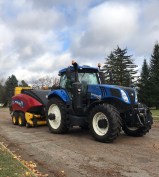 one local farmer, Steve Kramm, who uses his New Holland T8 and 330P Square Baler to pick up and bale leaves for the city of Mosinee. The operation, which finished up its 8thyear this fall, is swift and efficient taking only 2 days to do the entire city. Steve works with his cousin Ben, who runs a skid steer with a leaf plow in front of Steve’s T8, pushing the leaves into a windrow. The leaf windrow enables the baler to pick the leaves up easier and quicker. The team typically does 20-25 bales per hour, with each bale weighing around 1500 lbs.
Steve has made small modifications to the 330P baler and the operation as a whole over the last 8 years. They’ve learned tips and tricks such as not baling the bales too tightly to avoid bursting when they hit the ground, which keeps things running smoothly. The bales are then picked up with a wheel loader and placed into a truck to be hauled just north of the area to Hsu’s Growing Supply in Wausau. While Hsu’s is known internationally as one of the largest ginseng suppliers, they also sell various growing supplies such as compost, soil, and mulch. The leaf bales are used in their compost. During the leaf baling operation, three trucks are run at all times with each truck holding 13-14 bales per trip.
When Steve isn’t baling leaves, he focuses on custom farming, and helps raise heifers and does cash crops with his uncle and cousin at a farm outside of Mosinee. Steve and Ben also operate a snow removal business. Steve prefers operating the skid steers which happens to be a hidden talent of his. Steve won the Swiderski Equipment Skid Steer Rodeo a few years back. A Skid Steer rodeo tests an operator on machine handling, accuracy, and speed through a strategic obstacle course. Steve went on to compete at the National Competition, where he placed 10th overall.
The sight of a T8 and 330P baler baling leaves in the city is a sight to be seen and each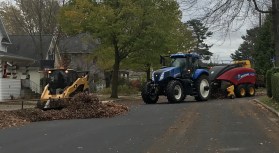 year residents and those traveling by stop and photograph the operation for its uniqueness. While it may not be a typical use for the equipment, it does provide an efficient means to clear a job most individuals dread and here at Swiderski Equipment, we can’t help but enjoy the sight of the New Holland logos sweeping through the city of Mosinee each fall!

Partner Spotlights: Patrykus Farms
In the small farming community of Almond, Wisconsin, sits the shop of Patrykus Farms, one of the largest carrot producers in the United States. Owned and  operated by Dave, Kelly, Zac, and Dalton Beggs, the farm has been passed down through several generations, starting with Kelly’s grandparents during The Great Depression. With the help of their sons, Dalton and Zac, the family has seen the farm grow from 30 acres to 2000 acres, since its founding 75-plus years ago.
Team work plays a crucial role in the long-standing success of Patrykus Farms. Everyone plays an important part in helping make the farm be as successful as possible. While Dave, Zac, and Dalton manage the in-field farming operations and have primary employee management responsibilities, Kelly describes herself as the “silent partner with a big, fat fist.” She works in the office managing day-to-day duties such as bookkeeping and payroll, along with a host of other general office responsibilities that ensure their operation continues to run smoothly. In addition to Dave, Zac, and Dalton, the farm employs three other full-time workers year-round, and employs up to 15 seasonal workers to help efficiently plant and harvest each year.
Patrykus Farms originally started with a diverse mix of crops such as potatoes, carrots, corn, snap beans, and peas. Over time, the decision was made to transition to only carrots, allowing the farm to maximize profit margins. With their sights set on quality not quantity, the family has made several tweaks in their operations to produce a more superior crop. Without giving away all of their secrets, Dave credits extremely strict weed and pest control solutions to their success. Some of the more significant solutions include spraying daily throughout the season, mowing around the fields to control the spread of insects, and discing the headlands which creates an immaculate looking field for the success of their crops.
Planning ahead and time management are two key components of a successful farming operation. Before planting can begin, the fields must be tilled and fertilized which happens around the middle of April. Patrykus Farms plants two varieties of carrots, slicers and dicers. Slicers are smaller carrots that grow between ¾ to 1 ½ inches in height. Because of their smaller size, they are the first variety to be harvested. Slicers are used mostly for canning, whereas dicers usually end up in the freezer section and, typically, grow to be 1 to 4 inches in length. The smaller size of slicers allows for more carrots to be planted per acre, as slicers are planted at 600,000 seeds per acre, compared to dicers being planted at 250,000 seeds per acre. Once planting is completed, the maintenance of the fields becomes the top priority until the carrots are ready to be harvested beginning in July and continuing until the ground freezes.
Harvest is a very busy season for Patrykus Farms, much like any farm in the area. They typically begin digging in July and end around Thanksgiving. The harvesting operations have drastically improved with the advancement of farming equipment and technology. What began with a single pull type harvester has grown to a much larger scaled operation consisting of two self-propelled Asa-Lift harvesters, which happen to be the only two in North America. These harvesters are built and shipped from Denmark. Patrykus Farms has their own trucking division, Diamond P Produce LLC that transports the carrots during harvest which is definitely a benefit for their business. A typical day can have anywhere from 20 to 40 semi loads of carrots being shipped out with 43 semi loads being their personal best to date. Each truck carries around 50,000 pounds of carrots.
Weather plays a large role in the yield outcome of any crop, and this summer’s cold and wet conditions weren’t exactly ideal for growing carrots. Dave believes the weather may have possibly delayed the carrots, but they’re still great quality which is something the farm strives for each year. The carrots are mostly grown in sandy soil, so excess water from a hard rain is absorbed far easier than it would be in muck or clay soil. This greatly benefits the farm by allowing them to work the fields without worry of flooding. When the farm first started focusing on carrots, the crops were planted in the muck soil, but Dave soon realized that the benefits of growing his carrots in sandy soil were far greater than planting in muck soil. This is also beneficial to the canning companies because the carrots that are grown in sandy soil can be steamed in less time than carrots grown in muck soil.

Patrykus Farms understands the value of having the right partners to support their operation and has appreciated the service they’ve received from Swiderski Equipment. While the operation utilizes a variety of equipment in day-to-day operations, Dave has long been impressed with the quality of the New Holland tractors, and he states, “It goes back to the service of the dealership.” Dave shared his experience of demo-ing two new tractors back in the late 1980s, one was a new Ford tractor which outshined its competition. Dave credits the success to the dealership by setting up the tractor properly from the start. Patrykus Farms bought the first New Holland Genesis 8970 sold in the US and commended the high quality and user-friendliness of the tractor.
When asked where he envisions the farm in ten years, Dave said one word, “high-tech.” Patrykus Farms uses a large span of technology, including their impressive harvesters and Trimble GPS systems in their tractors. Being the first farm to own a Trimble unit in Wisconsin certainly had its advantages during planting season. Dave recalls a friendly competition several years ago between growers to see who could plant the straightest rows, and no one seemed to understand how Patrykus Farms was able to plant so straight. Soon after, Trimble seemed to gain popularity over most of the area. With high demands for increased productivity and efficiency, technology continually keeps agriculture and farming practices moving forward and Dave plans to continue keeping the farm as “high-tech” as possible. He credits his sons’ encouragement in utilizing technology on the farm stating, “If it weren’t for my boys being so involved in the farm, I probably wouldn’t have as much technology as we have now, but everything ties into technology. We have more tonnage from less acres than we did ten years ago, and it’s all because of the technology that we have access to today. I can guarantee that years from now they’ll have tractors that drive themselves while we control them from a computer.” Time will tell, but we can certainly count on Patrykus Farms continuing to produce top-level carrots for years to come.

 swiderski.blog